

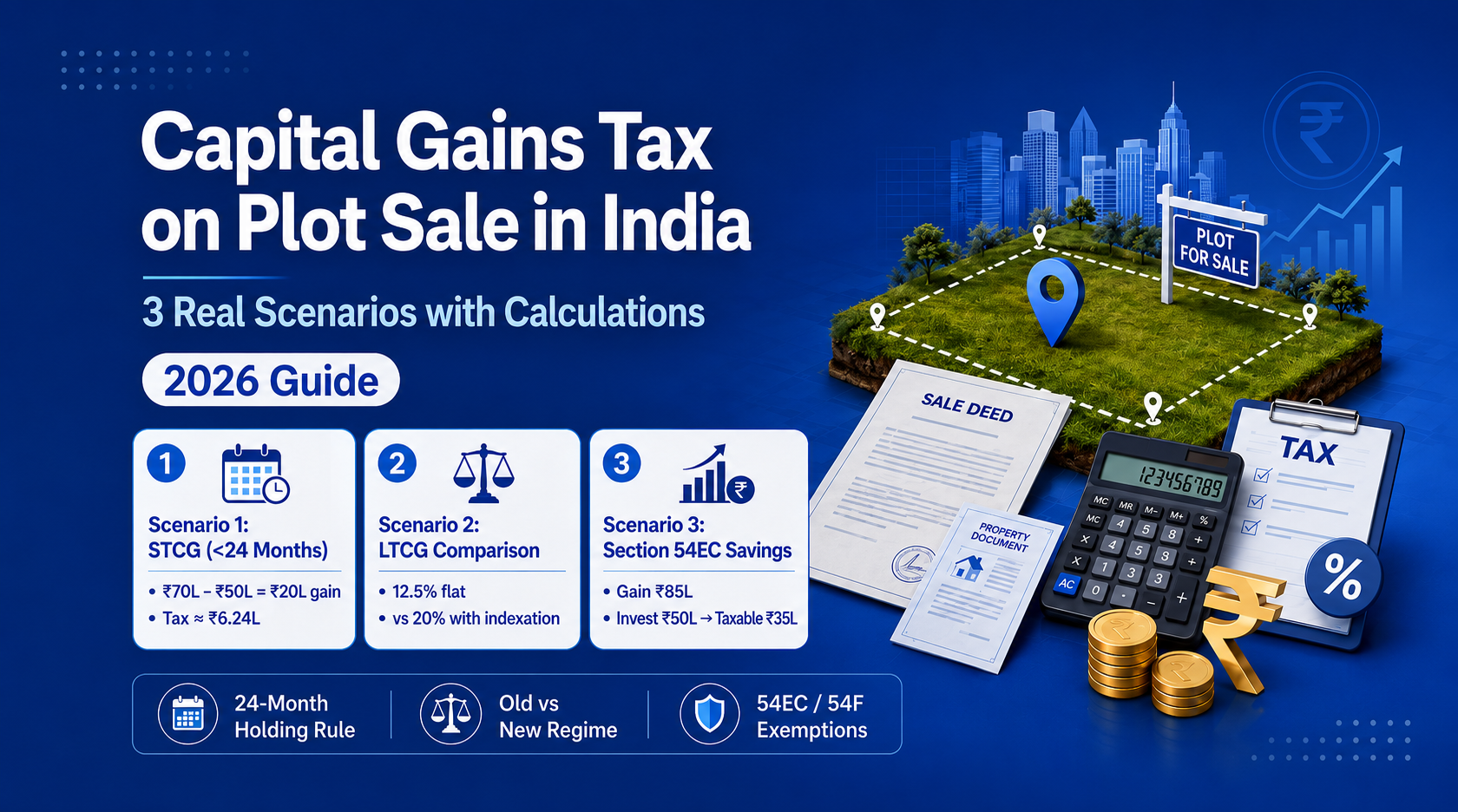
Selling a plot in India can deliver life-changing returns — but the tax bill on capital gains often surprises sellers who didn’t plan ahead. With Budget 2024 introducing a brand-new flat-rate option for long-term capital gains and removing indexation for properties bought after 23 July 2024, the rules of the game have changed materially.
This guide breaks down capital gains tax on plot sale in India through three real-world scenarios with full calculations, so you know exactly what you’ll pay — and how to legally save lakhs using exemptions like Section 54EC, 54F, and the dual-regime choice on older purchases.
Capital Gains on Plot — The Basics in 60 Seconds
When you sell a plot of land at a profit, the gain is taxable as Capital Gains under the Income Tax Act. The tax treatment depends on one critical factor: how long you held the plot.
- Holding period ≤ 24 months → Short-Term Capital Gain (STCG), taxed at your slab rate.
- Holding period > 24 months → Long-Term Capital Gain (LTCG), taxed at a flat 12.5% (no indexation) for most cases. For plots bought before 23 July 2024, you get a one-time choice between the new 12.5% flat rate and the old 20% with indexation — pick whichever is lower.
Sounds simple, but the actual numbers move based on cost inflation index, exemption usage, and whether you’re a resident or NRI. Let’s see how it plays out in practice.
Scenario 1: Short-Term Capital Gain (Plot Held Under 24 Months)
Situation: Ramesh bought a 200 sqyd Wave City Plot Ghaziabad in June 2024 for ₹50 lakh. He sold it in December 2025 for ₹70 lakh.
Holding period: ~18 months → Short-Term Capital Gain (STCG)
Calculation:
| Item | Amount (₹) |
|---|---|
| Sale price | 70,00,000 |
| Less: Cost of acquisition | 50,00,000 |
| Less: Brokerage / transfer expenses (assume nil) | 0 |
| Short-Term Capital Gain | 20,00,000 |
| Tax @ 30% slab + 4% cess | 6,24,000 |
Key takeaway: Selling a plot within 24 months is the most expensive exit. There’s no indexation, no Section 54 / 54F / 54EC exemptions are available against STCG on plot sale, and the gain is added to your total income — pushing many sellers into the highest 30% slab.
Smart move: If your sale is voluntary and the gain pushes you over a slab threshold, holding the plot for at least 24 months makes the gain LTCG and unlocks every major exemption. Even a 3–6 month delay can save several lakh in tax.
Scenario 2: Long-Term Capital Gain — Old vs New Regime Choice (Post Budget 2024)
Situation: Sunita bought a plot in March 2018 for ₹30 lakh. She sold it in April 2026 for ₹95 lakh.
Holding period: 8 years → Long-Term Capital Gain (LTCG)
Because the plot was acquired before 23 July 2024, Sunita can pick whichever of the two methods gives her the lower tax — the new flat 12.5% rate or the old 20% with indexation.
| Method | Calculation | Tax Payable |
|---|---|---|
| New regime: 12.5% flat, no indexation | Gain = ₹95L − ₹30L = ₹65L | ₹8,12,500 |
| Old regime: 20% with indexation | Indexed cost ≈ ₹30L × (363 ÷ 272) = ₹40.04L Gain = ₹95L − ₹40.04L = ₹54.96L |
₹10,99,200 |
Result: The new 12.5% regime saves Sunita roughly ₹2.86 lakh.
Key takeaway: For plots bought 5–10 years ago in moderate appreciation areas, the new 12.5% flat regime usually wins. But for plots held 15+ years where indexation builds up significantly, the old 20% regime can still come out ahead. Always run both calculations before filing — the choice is yours, and there’s no penalty for picking the lower one.
Important: This dual-option benefit is available only to resident individuals and HUFs, and only for plots acquired before 23 July 2024. NRIs, companies, and post-July-2024 purchases are locked into the new 12.5% regime with no indexation.
Cost Inflation Index (CII) — Quick Reference for Old-Regime Calculations
| FY | CII |
|---|---|
| 2001–02 (base) | 100 |
| 2017–18 | 272 |
| 2020–21 | 301 |
| 2023–24 | 348 |
| 2024–25 | 363 |
| 2025–26 | 376 |
Indexed cost formula: Cost of acquisition × (CII of sale year ÷ CII of purchase year)
Scenario 3: Long-Term Gain Saved Using Section 54EC Bonds
Situation: Rajesh sold his plot in May 2026 for ₹1.2 crore. He bought it in 2015 for ₹35 lakh. Under the new regime, his LTCG works out to ₹85 lakh.
Strategy: Within 6 months of sale, Rajesh invests ₹50 lakh in NHAI / REC / PFC capital gains bonds under Section 54EC.
| Item | Amount (₹) |
|---|---|
| Long-Term Capital Gain | 85,00,000 |
| Less: Section 54EC investment (max per FY) | 50,00,000 |
| Taxable LTCG after exemption | 35,00,000 |
| Tax @ 12.5% | 4,37,500 |
Versus no planning: Without Section 54EC, the full ₹85 lakh LTCG would be taxed at 12.5% = ₹10,62,500.
Net saving: ~₹6.25 lakh — plus Rajesh earns roughly 5.25% interest annually on the ₹50 lakh bond (5-year lock-in).
Key takeaway: Section 54EC is the simplest and most popular exemption for plot sellers because it doesn’t require buying another property. But three rules must be followed strictly:
- Maximum investment: ₹50 lakh per financial year, even if the gain is larger.
- Investment window: must be made within 6 months of the date of plot sale.
- Lock-in: 5 years. Premature redemption or borrowing against the bond will reverse the exemption and trigger tax in the year of breach.
Bonus: Section 54F — Full Exemption by Buying a Residential House
If your gain is large and you don’t want to lock money in 54EC bonds, Section 54F offers a cleaner route: invest the entire net sale consideration (not just the gain) in a residential house within the prescribed window, and the LTCG becomes fully exempt.
- Buy a ready house: within 1 year before or 2 years after the sale, OR
- Construct a house: within 3 years of the sale.
- You must not own more than one residential house (other than the new one) on the date of plot sale.
- Cap on exemption: ₹10 crore total investment value (introduced in Budget 2023).
If you reinvest only part of the sale consideration, the exemption is allowed proportionately.
Common Mistakes That Cost Sellers Lakhs
- Counting holding period from registry date instead of allotment letter date — for builder/authority allotments, holding period starts from the allotment date, not registration. This often pushes a borderline sale from STCG to LTCG.
- Forgetting to add stamp duty, registration, brokerage, and improvement costs — these all add to your cost of acquisition and reduce taxable gain.
- Missing the 6-month Section 54EC window — bonds purchased on day 181 are fully ineligible. No exceptions.
- Not depositing unutilised gain in the Capital Gains Account Scheme (CGAS) before ITR filing due date — required if you’re claiming Section 54F but haven’t yet completed the house purchase/construction.
- NRIs ignoring TDS u/s 195 — the buyer is required to deduct TDS at 12.5% (LTCG) or slab rate (STCG) on the entire sale consideration unless the seller obtains a Lower Deduction Certificate (Form 13) from the AO.
Frequently Asked Questions
Q1. Can I claim both Section 54EC and Section 54F on the same plot sale?
Yes. The two sections are independent. You can invest ₹50 lakh in 54EC bonds AND buy a residential house under 54F to exempt the balance.
Q2. Is agricultural land sale taxable?
Rural agricultural land (as defined under section 2(14)) is not a “capital asset” — its sale is fully exempt. Urban agricultural land is taxable like any other plot.
Q3. What if I sell at a loss?
Long-term capital loss can be set off only against long-term capital gain, and carried forward for 8 assessment years. Short-term loss can be set off against both STCG and LTCG.
Q4. Do I need to file ITR if my only income is plot sale gain?
Yes. Capital gains require filing ITR-2 (for individuals/HUFs without business income). Filing is mandatory if total income before exemptions exceeds the basic exemption limit.
Q5. Are there any state-level taxes apart from income tax?
Income tax on capital gains is a central tax. However, the buyer pays stamp duty and registration charges (state subjects) at the time of registry — these don’t affect the seller’s tax liability directly but are part of the buyer’s cost of acquisition for future sales.
Selling as a Real Estate Business?
If you’re selling plots regularly as part of a real estate business (not as a one-time investor), the gain is treated as business income instead of capital gains — different tax rules apply, and you may need to register for GST as a property dealer once your annual turnover crosses the threshold. See our complete guide to GST registration in India if you operate at this scale, and our guide to GST returns for the monthly/quarterly compliance once registered.
Plan Before You Sell — Save Lakhs Legally
Capital gains tax on plot sale isn’t a fixed bill — it’s a planning exercise. Whether you’re sitting on a 200-sqyd plot bought a decade ago or a recent investment due for exit, running the numbers across STCG vs LTCG, old vs new regime, and 54EC/54F exemptions can save anywhere from ₹2 lakh to ₹15+ lakh.
Before you sign the sale deed, talk to a qualified Chartered Accountant — and if your plot sale involves NRI status, joint ownership, inherited title, or under-construction allotment, get the planning done at least 60 days before registry. The exemptions only work if you act within the windows defined by law.
Disclaimer: This article is for informational purposes only and is based on the Income Tax Act provisions as on date of publication. Tax laws change frequently. Please consult a Chartered Accountant or tax advisor for advice specific to your transaction.